Joshua Bird built a ceramic 3D printer using an air-compressor clay extruder
Joshua Bird's custom clay extruder uses an air compressor and stainless steel auger to print pottery. The process works, but shrinkage, abrasion, and a two-fire ceramic workflow make it genuinely hard.
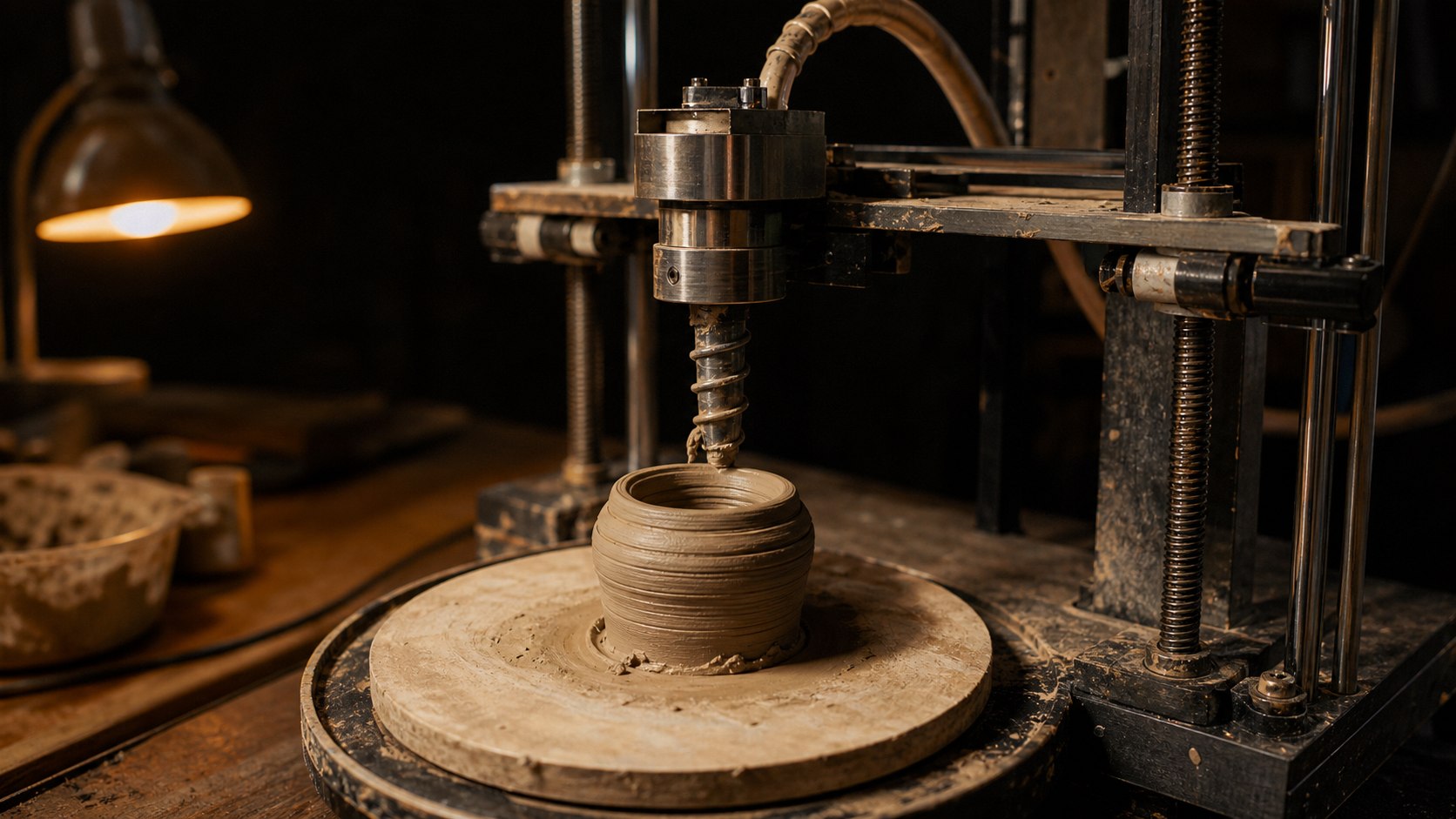
Joshua Bird built a ceramic 3D printer from scratch, and the writeup on Hackaday is a good read precisely because nothing about it was easy. The motion system is a polar design (an adaptation of his earlier non-planar 4-axis printer) and the extruder is the interesting part: an air compressor pushes clay along a tube into an auger that squeezes it through the nozzle, with a gap at the top to let trapped air escape.
The hard problems came in pairs. Rheology first: clay needs to be soft enough to flow through the nozzle but stiff enough to hold a bridge without collapsing. Bird solved that by pressurizing the clay as much as possible, which lets you run stiffer mixtures. Abrasion second: clay ate through every 3D-printed plastic auger he tried, usually inside an hour. A stainless steel auger fixed it. The full workflow per part is: mix the clay, load the tube, print, clean the extruder, dry it, fire it, glaze it, fire it again. Shrinkage during drying and firing killed a lot of prints. The ones that survived include a double-walled cup, a climbing-themed cup, and a chain-mail mesh, which is a genuinely impressive test piece for a material that collapses bridges.
Ceramic printing sits at the niche end of maker 3D printing for good reason. The material science alone is a different discipline from FDM, and the toolpath-to-finished-object pipeline has more steps than most makers want to deal with. Bird’s build is proof it works on a DIY budget, and the polar motion system is a clever fit for circular pottery forms. Worth watching for a future guide on non-standard extrusion materials.