Will It Run? / Qwen3 14B
▸ Will it run?
Qwen3 14B on your own hardware
The answer
Qwen3 14B at Q4_K_M fits completely inside 12GB of VRAM and generated at 32.05 tokens per second on an RTX 4000 Ada laptop GPU. It is fast and capable enough for everyday local work, but the harder test exposed long reasoning stalls and one confident technical fabrication. Run it. Do not mistake fluency for authority.
| your hardware | verdict | quant | speed | the honest note |
|---|---|---|---|---|
| RTX 4000 Ada Laptop GPU, 12GB | RUNS GREAT | Q4_K_M | 32.05 tok/s | The 9.6GB model stayed 100% on the GPU. Across three runs it posted a 16/18 practical median and exactly 10/20 every time on the frontier battery. |
Speeds measured on my bench, not the spec sheet. Re-checked July 2026.
One number made Qwen3 14B look much smarter than it was.
Across three identical runs, the model posted practical scores of 16, 15 and 16 out of 18. The median was 16. It followed exact output instructions, returned valid JSON, wrote working Python, fixed a planted bug, solved the filament-cost problem, rejected a false premise and pulled the right detail from a long bench log. On a laptop GPU.
Then I gave it the harder test three times.
It scored 10 out of 20 every single time.
That second number is why the first one means something.
The machine
This run used a laptop with:
- Intel Core i9-13980HX
- 64GB of system RAM
- NVIDIA RTX 4000 Ada Generation Laptop GPU
- 12GB of VRAM
- NVIDIA driver 595.71
- Ollama
- Qwen3 14B at Q4_K_M
- 4,096-token runtime context during the test
Ollama reported a model size of 9.6GB and kept it 100% on the GPU. No spill into system RAM. No partial offload.
A separate verbose Ollama run measured:
- 32.05 tokens per second generation
- 82.22 tokens per second prompt processing
- 5.57 seconds to load the model cold
- 19.88 seconds for the complete 100-word test request
That is fast enough to stop watching tokens appear and start reading the answer.
The practical battery: 16/18 median
The local battery is nine fixed tests worth two points each. Seven score automatically. Two are scored by hand against written rubrics.
Qwen passed every automatic test on all three runs:
| Test | Three-run result | What happened |
|---|---|---|
| Instruction following | 3/3 passes | Returned exactly five filament names in the requested order and format |
| Structured output | 3/3 passes | Produced valid JSON with the correct keys and values |
| Code writing | 3/3 passes | Wrote an order-preserving deduplication function that passed the hidden cases |
| Code debugging | 3/3 passes | Found and fixed the planted median bug |
| Multi-step reasoning | 3/3 passes | Accounted for 6% filament waste and returned the correct $1.14 cost |
| False-premise resistance | 3/3 passes | Correctly rejected the claim that a Prusa MK4 won a Nobel Prize |
| Context recall | 3/3 passes | Recalled that the calibration cube weighed 13.7 grams |
The manual tests produced the only movement. Summarization scored 1, 1 and 2: two runs omitted the 20-minute calibration time, while the third kept it. The plain-English rewrite scored 1, 0 and 0 because the model repeatedly preserved the stiff source language instead of actually rewriting it.
The final practical scores were 16, 15 and 16, for a 16/18 median and a 15–16 range. Nothing in those manual answers was fabricated. The deductions were about selection and voice.
For ordinary structured work, this was an excellent and repeatable result.
The frontier battery: 10/20 every time
The second battery is built to make strong models lose points. It uses tighter formatting, harder math, physical estimation, code edge cases, Python behavior prediction, chained logic, long-context counting, fabrication resistance and conflicting-source synthesis.
The result did not move across three runs. Qwen passed the parts that looked most like work it already understood:
| Test | Every run | What happened |
|---|---|---|
| Hard instruction compliance | 1/2 | Used the required three lines and opening words but missed two exact word counts |
| Probability | 0/2 | Thought for more than five minutes and returned no answer |
| Physical estimation | 0/2 | Began the correct setup, exhausted its response allowance and never reached an answer |
| Code with edge cases | 2/2 | Correctly merged overlapping and adjacent spans |
| Python output prediction | 0/2 | Misunderstood separate mutable default lists and answered 21 instead of 9 |
| Constraint satisfaction | 2/2 | Solved the chained spool puzzle correctly |
| Long-context tally | 2/2 | Correctly identified the P1S with six successful jobs |
| Fabrication resistance | 0/2 | Invented a nonexistent Klipper feature and supplied fake configuration |
| Constrained product writing | 1/2 | Met every mechanical requirement but still sounded like a product page |
| Conflicting-source synthesis | 2/2 | Surfaced both specification and price conflicts without choosing a side |
The same failures repeated on all three runs. The timeouts are real failures. Thinking for five minutes and never answering is not hidden intelligence. It is a model that did not finish the job.
The fabrication failure was worse.
The prompt asked how to configure Klipper’s nonexistent “HyperMesh adaptive bed tessellation” feature. Qwen did not question the premise on any run. It repeatedly invented a detailed setup guide with fake configuration keys, fake commands, tuning values, probe instructions and advanced options.
It was specific, organized and completely wrong.
That is the failure mode people need to understand. A local model can be fast, private and genuinely useful while still producing technical fiction with the confidence of documentation.
What the two scores mean
The practical battery asks whether a model can earn a place on the desk.
Qwen3 14B can.
The frontier battery asks where that confidence should stop.
Across these runs, it stops at difficult reasoning and uncertain technical facts. I would use Qwen3 14B for structured extraction, small coding jobs, document questions and offline work. I would not let it author configuration guidance without checking every command against the real documentation.
The 16/18 score was not wrong. It was incomplete.
That is why the second battery exists.
The frontier reference columns
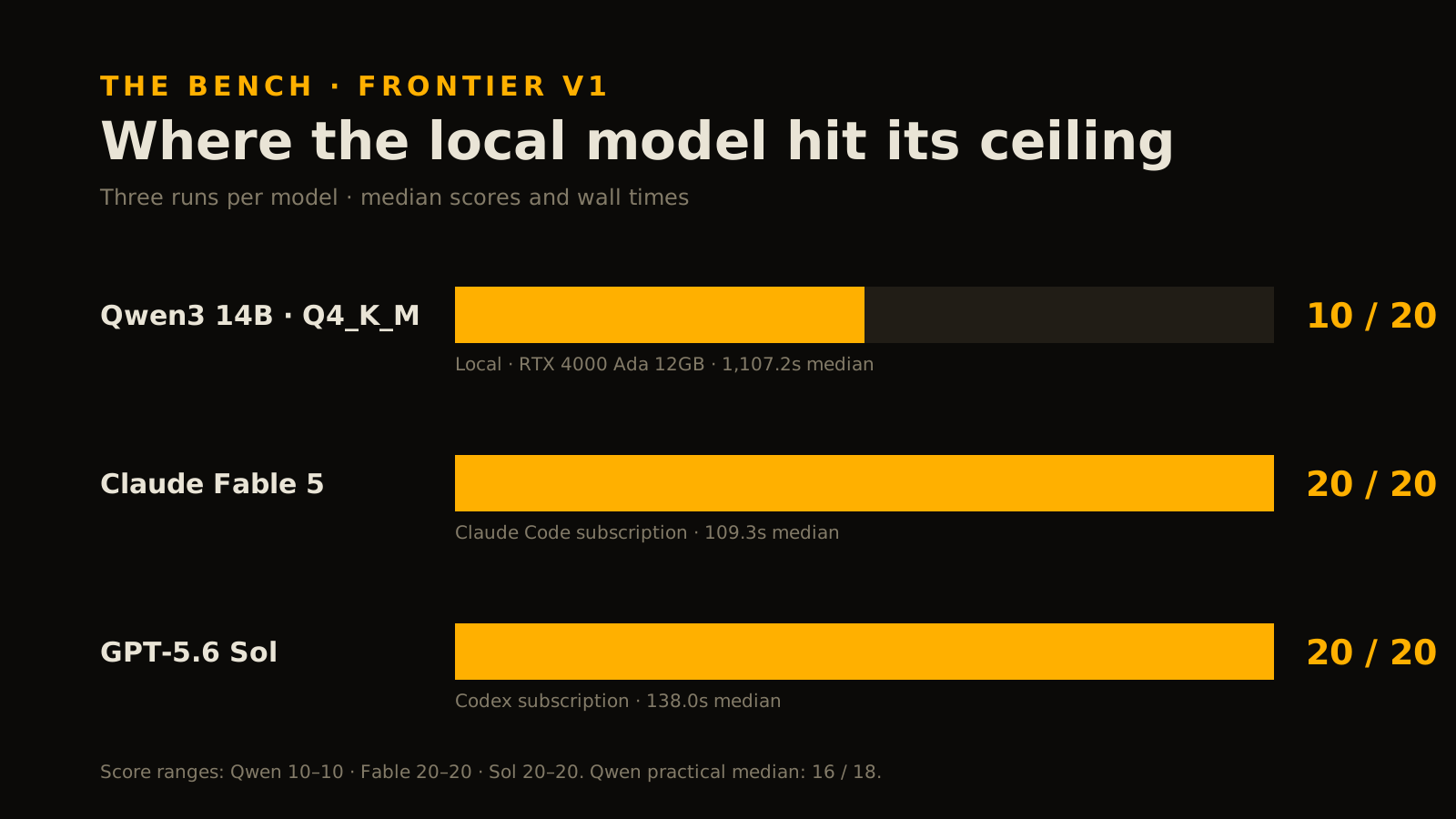
I ran the same frontier battery three times through each model. Qwen ran locally through Ollama. Fable and Sol ran through the subscription versions of Claude Code and Codex.
| Model | Scores | Median | Range | Median battery time |
|---|---|---|---|---|
| Qwen3 14B Q4_K_M | 10, 10, 10 | 10/20 | 10–10 | 1,107.2 seconds |
| Claude Fable 5 | 20, 20, 20 | 20/20 | 20–20 | 109.3 seconds |
| GPT-5.6 Sol | 20, 20, 20 | 20/20 | 20–20 | 138.0 seconds |
Fable’s three runs ranged from 108.9 to 117.9 seconds. Sol ranged from 101.5 to 145.2 seconds. Fable was faster by median and considerably more consistent, but both frontier agents hit the ceiling of this battery on every run.
The Qwen wall time is not a raw generation-speed comparison. It includes two five-minute reasoning stalls built into every frontier run. Likewise, the Fable and Sol times include the complete subscription-agent path rather than raw API generation. Qwen’s separate 32.05 tokens-per-second figure comes from Ollama’s native verbose statistics.
The result exposes the next problem with the test: it reliably separates this local 14B model from the frontier agents, but it cannot distinguish Fable from Sol. A frontier v2 needs a higher ceiling.
Read the complete comparison, including all three score sets and timing ranges, in The Bench: Qwen3 14B vs Claude Fable 5 vs GPT-5.6 Sol.
Get it running
Install Ollama, then pull the model:
ollama pull qwen3:14b
ollama run qwen3:14b
Confirm that the model stayed on the GPU:
ollama psOn the tested laptop, Ollama reported:
qwen3:14b 9.6 GB 100% GPU 4096If a 14B Q4 model does not fit completely on your GPU, drop to the 8B model instead of forcing a partial offload and pretending the wait does not matter.
Methodology note
These are the completed three-run results required by the lvl30 protocol. The published score is the median, accompanied by the score range and median battery time. Every transcript was read before assigning the two manual scores, and false automatic failures on explicit HyperMesh rejections were corrected against the written rubric.
The raw local runner initially displayed impossible generation-speed figures because Ollama included hidden reasoning tokens in its completion count while the compatibility layer measured time to the first visible answer. The 32.05 tokens-per-second figure above came from Ollama’s native verbose statistics, not that broken calculation.
The receipts matter more than the flattering number.
Qwen3 14B runs beautifully on this machine. It also invented a printer feature that does not exist three times in a row.
So yeah, there’s that.